|
WATER
SOFTENERS
 Soft
water saves up to 70% in soap costs and 22% in hot water energy.
You'll enjoy the difference soft water makes to your hair &
skin. At direct prices from Pure North, everyone can enjoy the
benefits of our Purifiner Water Softeners. You will save time
and effort by not having to clean up after your water. Soft
water saves up to 70% in soap costs and 22% in hot water energy.
You'll enjoy the difference soft water makes to your hair &
skin. At direct prices from Pure North, everyone can enjoy the
benefits of our Purifiner Water Softeners. You will save time
and effort by not having to clean up after your water.
WATER
SYSTEMS
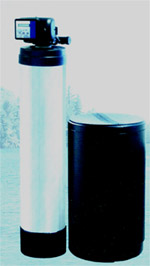 Purifiner
PDS Water Systems Purifiner
PDS Water Systems
Enjoy:
- Water that feels,
tastes and smells better
- Savings on soap
and cleaning products
- Reduced maintenance
on household applianced and fixtures
- Savings on Time
and Money
Features:
- Fully automatic
operation
- High reliability
- Safe low voltage
operation
- High efficiency
- Large ported valve
maximizes water delivery
- No batteries
WATER
SOFTENERS
They make hard water easy to get along
with.

Water
passing through the mineral tank loses positively charged
calcium and magnesium ions to negatively charged plastic beads.
The brine tank holds a salt solution that flushes the mineral
tank, replacing calcium and magnesium ions with sodium. A
meter at the top of the mineral tank regulates recharging
cycles. The valve assembly routes water flow for each phase
of the regeneration cycle. |
-
The Fix
- The Brains
- Judging Water Hardness
- Health Concerns
It's easy to
forget how important water is in our lives. Of course we
need it in our diet, but in our homes, it's a tool-a fluid
medium that carries material from one place to the next.
And one of the reasons it does this job well is that it's
very good at holding things, either by suspending them or
dissolving them.
Unlike most tools, though, water doesn't come with an instruction
manual. If it did, you'd know why the dishes you thought
were washed are covered with spots when dry, why the water
in your shower leaves a film on everything it touches, and
why what you thought was clean water has clogged up your
plumbing system. |
The
Solution Is The Problem
While water is in the ground, it picks up soluble bits of
whatever it passes through. While this can mean contamination
that makes the water unfit to drink, in many cases it simply
means that the water contains minerals found in the earth.
Of these, calcium and magnesium are of particular importance
because they affect the water's ability to function in our
homes. These minerals make our water hard.
One effect of hard water is that soaps and detergents lose
some effectiveness. Instead of dissolving completely, soap
combines with the minerals to form a coagulated soap curd.
Because less soap is dissolved, more is required. And the
sticky insoluble curd hangs around-it clings to the skin and
may actually inhibit cleansing. Washed hair seems dull and
lifeless.
In the laundry, things aren't much better. The soap curd can
work its way into your clothes as they're being washed in
your automatic washing machine. This can keep dirt trapped
in the fibers, and it can stiffen and roughen the fabric.
In addition to affecting the actual washing process, insoluble
soap deposits leave spots on everything you wash-from your
dishes to the family car-and a soap film will build up in
your bath and shower.
Another reason to be concerned about hard water is its effect
on your plumbing system. Calcium and magnesium deposits can
build up in pipes, reducing flow to taps and appliances. In
water heaters, these minerals generate a scale buildup that
reduces the efficiency and life of the heater. 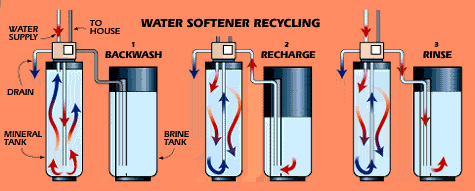
1.
The backwash phase removes dirt from the mineral tank.
2. Recharging the mineral tank with sodium from the brine
solution displaces calcium and magnesium, which is then
washed down the drain.
3. The final phase rinses the mineral tank with fresh water
and loads the brine tank so it's ready for the next cycle.
The
Fix
The solution to the problem is to get rid of the calcium
and magnesium. While there are chemical treatments that
do this, the most popular answer is a water softener.
The typical water softener is a mechanical appliance that's
plumbed into your home's water supply system. All water
softeners use the same operating principle: They trade the
minerals for something else, in most cases sodium. The process
is called ion exchange.
The heart of a water softener is a mineral tank. It's filled
with small polystyrene beads, also known as resin or zeolite.
The beads carry a negative charge.
Calcium and magnesium in water both carry positive charges.
This means that these minerals will cling to the beads as
the hard water passes through the mineral tank. Sodium ions
also have positive charges, albeit not as strong as the
charge on the calcium and magnesium. When a very strong
brine solution is flushed through a tank that has beads
already saturated with calcium and magnesium, the sheer
volume of the sodium ions is enough to drive the calcium
and magnesium ions off the beads. Water softeners have a
separate brine tank that uses common salt to create this
brine solution.
In normal operation, hard water moves into the mineral tank
and the calcium and magnesium ions move to the beads, replacing
sodium ions. The sodium ions go into the water. Once the
beads are saturated with calcium and magnesium, the unit
enters a 3-phase regenerating cycle. First, the backwash
phase reverses water flow to flush dirt out of the tank.
In the recharge phase, the concentrated sodium-rich salt
solution is carried from the brine tank through the mineral
tank. The sodium collects on the beads, replacing the calcium
and magnesium, which go down the drain. Once this phase
is over, the mineral tank is flushed of excess brine and
the brine tank is refilled.
In ion exchange, hard water ions replace sodium ions on
beads. Process is reversed to flush minerals away.
|
The
Brains
Most popular water softeners have an automatic regenerating
system. The most basic type has an electric timer that flushes
and recharges the system on a regular schedule. During recharging,
soft water is not available.
A second type of control uses a computer that watches how
much water is used. When enough water has passed through the
mineral tank to have depleted the beads of sodium, the computer
triggers regeneration. These softeners often have reserve
resin capacity, so that some soft water will be available
during recharging.
A third type of control uses a mechanical water meter to measure
water usage and initiate recharging. The advantage of this
system is that no electrical components are required and the
mineral tank is only recharged when necessary. When it is
equipped with two mineral tanks, softened water is always
available, even when the unit is recharging.
|
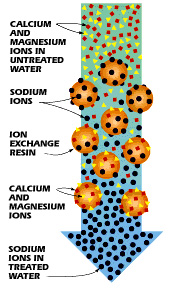 In
ion exchange, hard water ions replace sodium ions on beads.
Process is reversed to flush minerals away.
In
ion exchange, hard water ions replace sodium ions on beads.
Process is reversed to flush minerals away. |
Judging
Water Hardness
Companies that sell water softening equipment generally offer
test kits that help you determine the hardness of your water.
For commercial testing sources, check your Yellow Pages under
"water analysis."
Water hardness is measured in grains per gallon (GPG) or milligrams
per liter (mg/l, equivalent to parts per million, or ppm).
Water up to 1 GPG (or 17.1 mg/l) is considered soft, and water
from 1 to 3.5 GPG is considered moderately hard. Water from
3.5 to 7 GPG is Hard Water, and from 7 to 10.5 GPG is Very
Hard. A water softener's effectiveness depends on how hard
the incoming water is. Water over 100 GPG may not be completely
softened.
Health
Concerns
Hard water poses no health hazard. On the other hand, the
sodium that remains in softened water may be a problem for
those on sodium-restricted diets. Other people simply may
wish to avoid the slightly salty taste of treated water.
In either case you can install a separate water dispenser
that bypasses the softener. You also can use potassium chloride
instead of salt, although this costs about three to four
times more.
|
Click
here for water articles
Return to water quality section
|